
An early Ethereum wallet has returned to activity after more than a decade, transferring approximately $4.6 million worth of ETH while successfully avoiding an attempted cryptocurrency scam. The unusual transaction has attracted attention among blockchain analysts because the wallet dates back to Ethereum’s launch in 2015.
The wallet, identified by its address beginning with 0x7dDd, received its first Ether during Ethereum’s genesis block in July 2015. It subsequently received another 755 ETH in March 2016 but had not recorded any outgoing transfers until November 9, 2026.
The movement follows other cases involving early Ethereum wallets that have unexpectedly become active after years of inactivity.
Its sudden activity offers an interesting example of how long-term cryptocurrency holdings can appreciate significantly while also highlighting the security challenges associated with moving large amounts of digital assets.
According to blockchain monitoring reports, the wallet initiated a small test transaction before transferring almost its entire balance to another address.
However, the test payment immediately attracted the attention of automated scam operations monitoring Ethereum’s blockchain.
Ethereum Whale Awakens After More Than A Decade
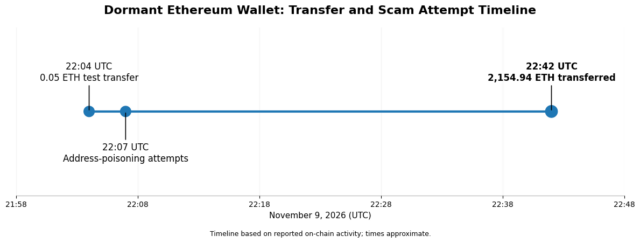
The wallet’s first outgoing transaction occurred at approximately 22:04 UTC on November 9, when it transferred 0.05 ETH, worth around $106, to a new receiving address.
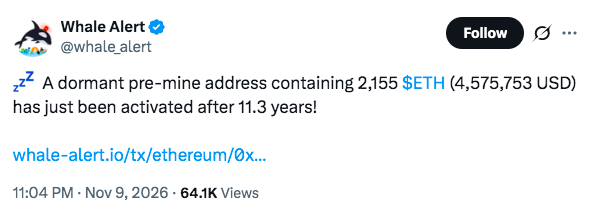
Blockchain tracking service Whale Alert identified the movement, bringing attention to a wallet that had remained inactive for more than 11 years.
Whale Alert (@whale_alert) — November 10, 2026
A dormant pre-mine address containing 2,155 $ETH (4,575,753 USD) has just been activated after 11.3 years!
Within approximately three minutes, the original wallet began receiving numerous tiny ETH transfers from two suspicious addresses designed to resemble the legitimate recipient.
Both fraudulent addresses copied portions of the original destination address, including its final characters.
One of the suspicious addresses reportedly initiated 43 small transfers, while blockchain explorer Etherscan identified the accounts funding the lookalike addresses as associated with phishing activity.
The attackers were attempting a technique known as address poisoning, which involves inserting misleading addresses into a wallet’s transaction history.
This type of address poisoning has become a growing concern for cryptocurrency investors because it exploits the way wallet addresses are displayed and copied.
Because many cryptocurrency wallets display only the beginning and ending characters of an address, users can mistakenly select a fraudulent recipient when copying information from previous transactions.
In this case, the attempted attack appears to have failed.
At approximately 22:42 UTC, around 38 minutes after the initial test, the original wallet transferred 2,154.94 ETH, worth approximately $4.6 million, to the intended destination.
The transfer was completed without the funds being redirected to the suspicious addresses.
What The $4.6 Million Transfer Reveals About Crypto Wallet Security
The transaction demonstrates how quickly automated scammers can respond to activity involving valuable cryptocurrency wallets.
Unlike traditional phishing attempts, which often rely on emails or malicious websites, address poisoning exploits the transparency of public blockchains.
Attackers can monitor transactions, identify potential targets, and generate visually similar addresses before a user completes a larger transfer.
The attackers reacted within minutes of the wallet becoming active, demonstrating how automated monitoring can be used to target large cryptocurrency transfers.
However, the owner appears to have taken precautions.
After the initial 0.05 ETH transaction, the receiving wallet sent a smaller 0.01 ETH transfer, with nearly all of the funds subsequently returned.
The main transaction followed shortly afterward, reaching the legitimate destination.
The incident also illustrates why test transactions alone cannot guarantee security. A small successful payment confirms that a particular address can receive funds, but users must still verify that the destination address has not changed before making another transfer.
Previous crypto scams have demonstrated how costly address-poisoning attacks can become when investors mistakenly transfer funds to fraudulent wallets.
For investors holding substantial cryptocurrency balances, the distinction is important.
A wallet can remain secure for years, yet the process of transferring funds introduces opportunities for attackers to exploit human error.
The latest transaction also raises questions about why the original holder decided to move the cryptocurrency after more than a decade.
Although the wallet’s history is publicly visible, its owner’s identity and reasons for transferring the funds remain unknown.
There is also no confirmed evidence that the transaction represents an immediate cryptocurrency sale.
For now, the successful movement of approximately $4.6 million in ETH highlights both the remarkable longevity of early Ethereum holdings and the importance of maintaining strong security practices as cryptocurrency adoption continues expanding.

You can get bonuses upto $100 FREE BONUS when you:
💰 Install these recommended apps:
💲 SocialGood - 100% Crypto Back on Everyday Shopping
💲 xPortal - The DeFi For The Next Billion
💲 CryptoTab Browser - Lightweight, fast, and ready to mine!
💰 Register on these recommended exchanges:
🟡 Binance🟡 Bitfinex🟡 Bitmart🟡 Bittrex🟡 Bitget
🟡 CoinEx🟡 Crypto.com🟡 Gate.io🟡 Huobi🟡 Kucoin.















Comments