
Bitcoin finds opportunity once again after struggling to gain traction as more than $1 billion in bullish cryptocurrency positions were liquidated within 24 hours, while institutional investors continued pulling money from spot Bitcoin ETFs. The combination of aggressive forced selling and a lack of fresh buying demand has raised concerns about whether BTC can maintain its current support levels.
Bitcoin was trading around $76,100 on Friday, November 6, down approximately 5.2% over the previous 24 hours. The decline followed a difficult session across traditional financial markets, where technology stocks experienced substantial losses amid growing uncertainty surrounding artificial intelligence investments.
Thursday’s sell-off was particularly damaging for leveraged traders. According to CoinGlass data, approximately $1.27 billion in cryptocurrency derivatives positions were liquidated over 24 hours, with more than $1.1 billion coming from bullish bets.
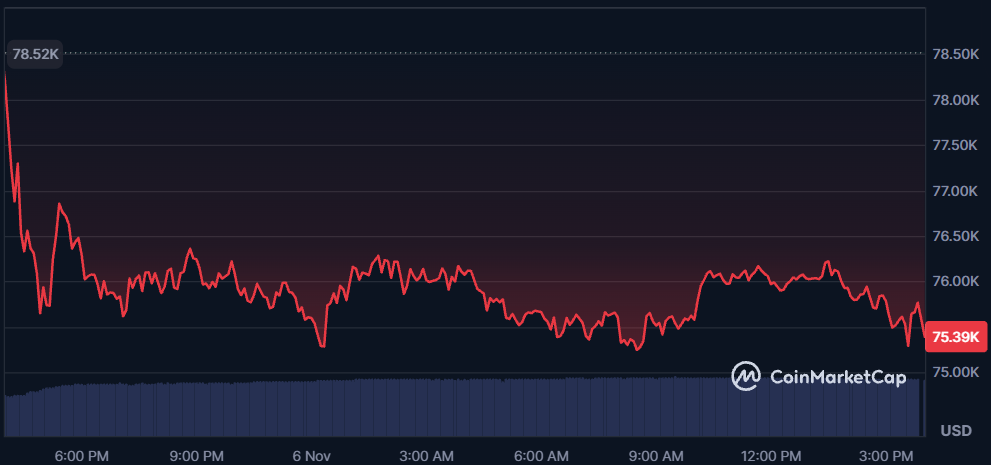
This means traders who had positioned themselves for higher prices accounted for the overwhelming majority of forced liquidations.
The latest developments also highlight a growing problem for Bitcoin bulls: while the market has already experienced a significant leverage reset, institutional demand has yet to provide the buying pressure needed to support a sustained recovery.
More Than $1.1 Billion in Long Positions Liquidated as Market Sentiment Weakens
The scale of Thursday’s liquidation event highlights just how quickly market sentiment has changed following Bitcoin’s post-election rally.
Bitcoin had briefly climbed above $80,000 earlier in the week, but the momentum faded as investors began reassessing their exposure to risk assets. The decline accelerated alongside the technology stock sell-off, with concerns about potential political opposition to AI data-center construction adding another layer of uncertainty.
South Korea’s Kospi also experienced significant selling pressure, falling as much as 8.8% and triggering a temporary 20-minute trading halt. The weakness across global markets eventually spread into cryptocurrencies, where leveraged positions amplified the downward move.
Carlos Guzman, vice president of research at GSR, described the situation as:
“A pullback in risk appetite amplified by leverage.”
This distinction is important because the decline was not necessarily driven by a sudden deterioration in the underlying fundamentals of every cryptocurrency project. Instead, falling prices triggered forced closures, which added further selling pressure and accelerated the correction.
When leveraged traders are forced out of their positions, the resulting market activity can create a feedback loop in which declining prices trigger additional liquidations.
For Bitcoin, the immediate challenge is now to establish a stable trading range after the latest wave of forced selling.
Bitcoin ETF Outflows Leave Bulls Without Institutional Support
One of the most concerning developments for Bitcoin is the continued weakness in institutional demand.
US spot Bitcoin ETFs recorded approximately $430.2 million in net outflows on Thursday, adding to the selling pressure already affecting the market.
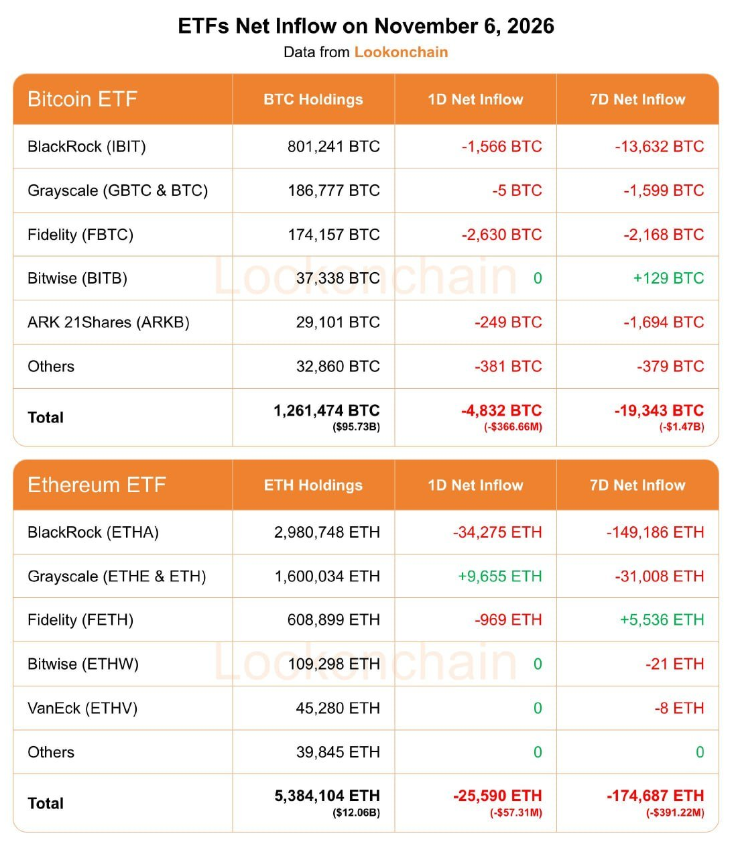
The withdrawals are particularly significant because spot ETFs have become an important source of demand for Bitcoin. When investors consistently redeem their holdings, the funds can become a source of additional selling pressure rather than the buying support bulls need. The latest figures also reinforce concerns raised earlier in the week by Bitfinex analysts, who warned that:
“Sustaining this bounce requires actual spot demand.”
Bitcoin can experience short-term rebounds as traders close bearish positions or speculative buyers enter the market. However, without stronger spot demand, those moves may struggle to develop into lasting upward trends.
Bitcoin Technical Outlook: $75K Support Becomes Increasingly Important
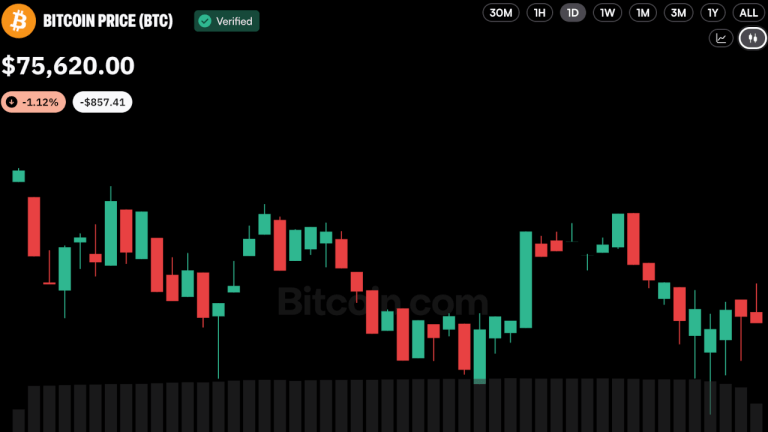
Looking at the technical picture, Bitcoin is approaching a critical area that could determine whether the current correction remains relatively contained or develops into a deeper downturn.
One particularly important development is Bitcoin’s move below the weekly 50-week exponential moving average (EMA), currently sitting around $78,400.
This level has historically been an important indicator of medium-term market direction. A weekly close below the 50-week EMA could signal a weakening bullish structure and suggest that sellers are gaining greater control.
Bitcoin is also testing the $75,000 region, which represents an important weekly support area.
Key Bitcoin price levels to watch
| Price level | Technical significance |
| $80,000 | Major recovery threshold |
| $78,400 | Weekly 50-week EMA |
| $75,000 | Important weekly support |
| $73,000 | Potential downside target |
| $68,000 | Deeper correction target |
For bulls, reclaiming $80,000 and holding above that level would provide a stronger indication that the market is recovering.
There is, however, one potentially constructive development. The latest technical assessment found no RSI divergences, suggesting that the market has not yet produced a clear divergence signal that would indicate an imminent reversal.
Nevertheless, the absence of such a signal does not guarantee that Bitcoin has reached its bottom.
For now, the $75,000 region remains particularly important. A sustained break below this area could expose BTC to further losses, while a successful defense could give buyers an opportunity to rebuild momentum.
US Jobs Report Could Become the Next Major Market Catalyst
Beyond cryptocurrency-specific developments, investors are also preparing for another important economic event that could influence Bitcoin’s short-term direction.
The October US employment report is expected to provide additional insight into the strength of the American economy and potentially influence expectations surrounding the Federal Reserve’s monetary policy. Economists are forecasting between 59,000 and 65,000 new jobs, compared with approximately 29,000 added in September.
The report comes at a particularly sensitive moment for financial markets. Investors are already concerned about slowing economic growth, technology-sector valuations, and the possibility that political uncertainty could affect investment decisions. A weaker employment report could increase expectations for monetary easing, potentially creating a more favorable environment for risk assets such as Bitcoin.
The broader picture remains challenging. More than $1.1 billion in bullish positions have already been liquidated, institutional ETF flows remain negative, and Bitcoin has fallen below an important weekly moving average.
For a convincing recovery to develop, the market will likely need more than a temporary rebound. Stronger spot demand, improving institutional flows, and a move back above $80,000 would provide more convincing evidence that bullish momentum is returning.
What do you think happens next?
Has the latest $1.1 billion liquidation event cleared enough leverage for Bitcoin to recover, or could continued ETF outflows push BTC toward $73,000 and eventually $68,000?
&

You can get bonuses upto $100 FREE BONUS when you:
💰 Install these recommended apps:
💲 SocialGood - 100% Crypto Back on Everyday Shopping
💲 xPortal - The DeFi For The Next Billion
💲 CryptoTab Browser - Lightweight, fast, and ready to mine!
💰 Register on these recommended exchanges:
🟡 Binance🟡 Bitfinex🟡 Bitmart🟡 Bittrex🟡 Bitget
🟡 CoinEx🟡 Crypto.com🟡 Gate.io🟡 Huobi🟡 Kucoin.

















Comments